-
 by Em News
- September 18, 2026
Sam George Challenges FBI Director Kash Patel Over Credit for Ghana Cybercrime Crackdown
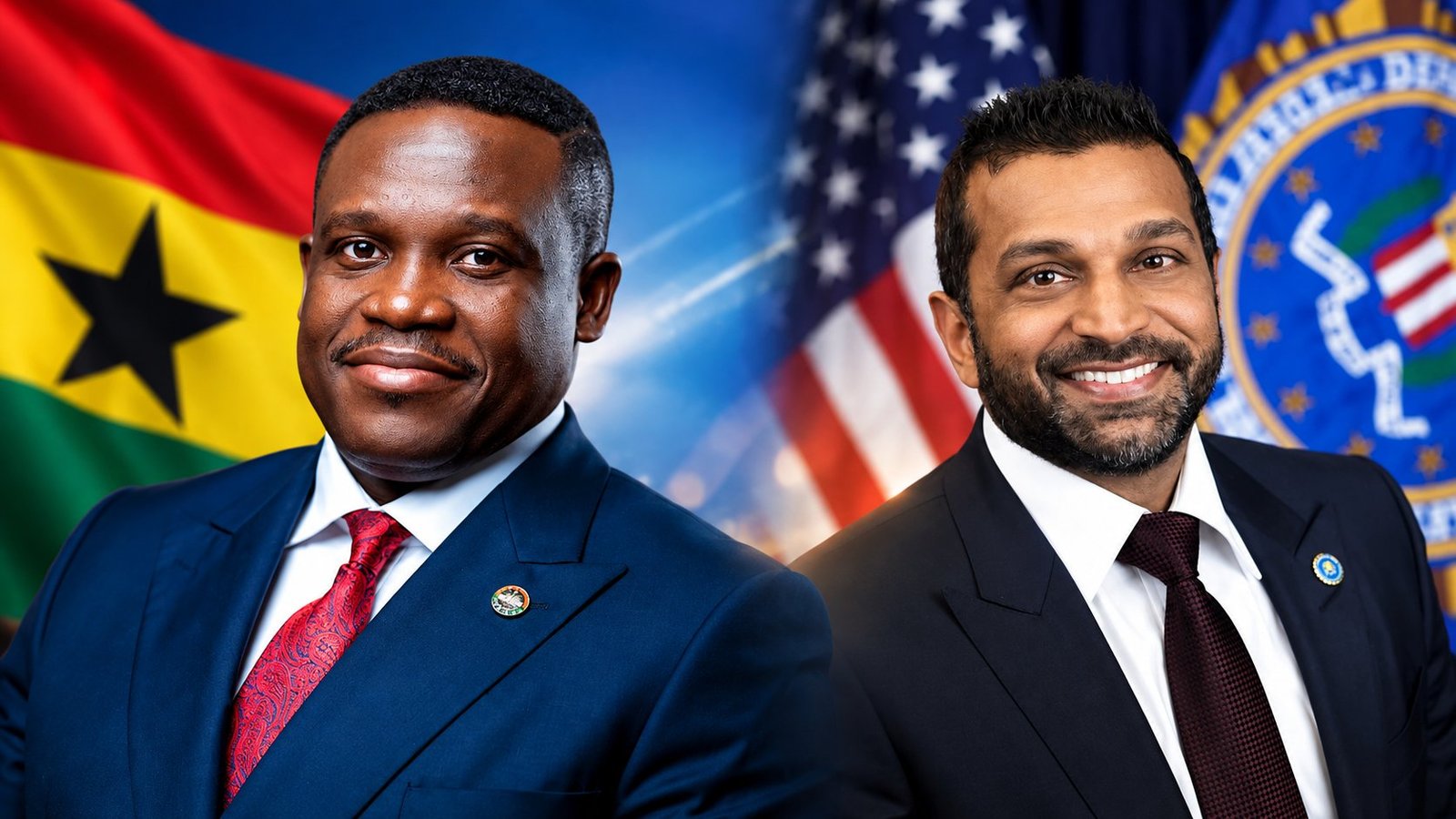
Ghana's Communications Minister has disputed the FBI's account of a major operation targeting suspected online fraud networks, insisting that Ghanaian security agencies led the crackdown with intelligence and operational support from international partners.
Ghana's Minister for Communications, Digital Technology and Innovations, Samuel Nartey George, has challenged FBI Director Kash Patel over the portrayal of a major cybercrime operation in Ghana, accusing the American law enforcement chief of failing to adequately acknowledge the role played by Ghanaian authorities.
The disagreement follows Patel's announcement of a crackdown on suspected online fraud networks under the FBI's international Operation Blackout initiative.
While the FBI director highlighted the operation as part of the bureau's efforts to dismantle transnational scam networks, Ghanaian officials insist that the exercise was planned, coordinated and carried out by local law enforcement and intelligence agencies, with assistance from foreign partners.
In a public response on Thursday, October 8, 2026, Sam George maintained that Ghana's Cyber Security Authority (CSA) and other national security institutions had taken the lead, while the FBI and the United Kingdom's National Crime Agency (NCA) provided important support.
The minister's intervention has brought an unusual public disagreement between security partners into the spotlight, raising questions about how multinational law enforcement operations are presented and who receives recognition for their success.
At the heart of the dispute is not whether the operation took place or whether international cooperation was necessary.
It is who directed the operation, who exercised law enforcement authority on Ghanaian soil and whether the FBI's public account accurately reflected those responsibilities.
Sam George Insists Ghanaian Agencies Led the Operation
Responding to Patel's announcement on X, Sam George said the fight against cybercrime required cooperation between countries and their law enforcement institutions.
He acknowledged the contributions of the FBI and the UK's National Crime Agency but challenged any impression that American agents had independently conducted the operation in Ghana.
According to the minister, the exercise was coordinated by Ghanaian security and law enforcement agencies under the leadership of the Cyber Security Authority.
His position was that international partners had provided assistance within a Ghana-led operation, rather than exercising independent enforcement powers in the country.
George also warned that public accounts which overlook the contributions of partner agencies could undermine the trust required to confront organised cybercrime.
His comments reflected a broader concern about the recognition of Ghana's security institutions in international investigations, particularly those involving foreign intelligence and law enforcement agencies.
For the minister, acknowledging international assistance and recognising Ghanaian leadership are not competing positions.
Both, he argued, are necessary for effective cooperation.
Cyber Security Authority Rejects Claims of FBI-Led Raid
The Cyber Security Authority subsequently reinforced the minister's position in a statement issued on October 8.
The authority said the operation, also known locally as Operation Cyber Hunt, was conceived, planned and executed by Ghanaian authorities in accordance with the country's legal and institutional procedures.
It rejected any suggestion that the FBI had independently directed or carried out enforcement activities within Ghana.
According to the CSA, the operation involved several domestic institutions, including the National Security Council, the Criminal Investigations Department of the Ghana Police Service, the Office of the Attorney-General and the Ghana Immigration Service.
The FBI, the UK's National Crime Agency and Nigeria's Economic and Financial Crimes Commission were among the international partners that contributed to the exercise.
The authority acknowledged the value of intelligence-sharing and technical cooperation with those agencies.
However, it stressed that foreign law enforcement organisations cannot independently exercise arrest powers or conduct police operations within Ghana without the appropriate legal authorisation and involvement of Ghanaian authorities.
The distinction is significant.
International agencies may help identify suspects, trace criminal networks and provide intelligence, but enforcement activities carried out within Ghana remain subject to the country's laws and jurisdiction.
The CSA's statement therefore sought to establish not only which institutions participated in the crackdown, but also the legal framework under which it was conducted.
Eight Arrested as 120 Suspected Trafficking Victims Rescued
Beyond the disagreement over the operation's leadership, the crackdown uncovered what Ghanaian authorities described as suspected organised cybercrime activities at residential properties across the Greater Accra Region.
According to the CSA, eight suspects were arrested, and 120 people believed to have been trafficked and exploited for online fraud activities were rescued.
The operation followed intelligence received on August 26, 2026, concerning suspected criminal networks operating from residential facilities.
The suspected activities included romance scams and other forms of online fraud.
Locations identified by the authority included Ubuntu Haven Estate in Kpone Katamanso, Franko Estate in Ga North and additional properties in Ga West.
Investigators recovered a substantial quantity of electronic equipment believed to be relevant to the suspected operations.
The items included 136 mobile phones, 130 laptops, internet connectivity equipment and four vehicles, one of which authorities said had been stolen from Canada.
Jewellery and 10 Nigerian passports were also recovered.
The CSA said most of the rescued individuals were Nigerian nationals and that arrangements were being made for their repatriation.
Investigations into the arrested suspects, the seized devices and the wider criminal network remain ongoing.
The arrests do not establish the guilt of those detained, and the allegations will be subject to the applicable investigative and judicial processes.
Different Figures Raise Questions About the Operation
The competing public accounts have also drawn attention to differences in how the results of the crackdown were reported.
In his announcement, Patel referred to more than 130 people arrested or detained during the operation.
The FBI director also reported 89 identified victims, nearly US$10 million in identified financial losses and more than 300 electronic devices seized.
Ghana's Cyber Security Authority, meanwhile, distinguished between the eight suspects arrested and the 120 people rescued from suspected exploitation.
Those figures should not automatically be interpreted as contradictory.
The agencies may have used different categories when describing suspects, victims and individuals taken into protective custody.
Similarly, the FBI's figures may reflect a broader accounting of devices, victims or financial losses connected to the investigation.
However, without a detailed reconciliation of the two sets of figures, it would be premature to treat them as directly equivalent.
The differences underline the importance of coordinated public communication, particularly when an operation involves multiple agencies and individuals who may themselves be victims of criminal exploitation.
Clear distinctions between suspects, detained persons and rescued victims are essential to ensuring that the public understands the outcome of such investigations.
A Dispute Over Recognition, Not Cooperation
Despite the strong language surrounding the disagreement, neither Sam George nor the Cyber Security Authority has rejected the importance of working with the FBI.
Their objection concerns the way the operation was publicly presented.
Patel's announcement placed the crackdown within the FBI's wider campaign against international scam centres, particularly networks suspected of defrauding American victims.
From that perspective, the Ghana operation formed part of a broader effort to disrupt criminal activities that extend beyond national borders.
Ghanaian authorities, however, have insisted that the international context should not obscure the responsibilities of the institutions that conducted the enforcement operation locally.
The distinction matters because successful cross-border investigations often depend on several agencies performing different roles.
One organisation may identify victims or trace financial transactions. Another may provide intelligence about suspects, while local authorities carry out surveillance, searches, arrests and evidence collection.
All those contributions can be essential to the outcome.
But describing the operation without clearly identifying those roles can create an inaccurate impression of how it was conducted.
The CSA has therefore called for clarification of the FBI's public account and recognition of the Ghanaian institutions involved.
The Human Cost Behind Online Fraud Networks
The discovery of 120 suspected trafficking victims also points to a more troubling dimension of the operation.
Cybercrime centres are often discussed primarily in terms of stolen money, fraudulent accounts and the people responsible for running scams.
But some organised fraud networks also rely on individuals who may have been recruited under false pretences, transported across borders or compelled to participate in criminal activities.
Such circumstances complicate law enforcement responses.
Investigators must distinguish between those suspected of organising and profiting from the schemes and individuals who may have been exploited within them.
That distinction is particularly important when rescued persons are foreign nationals who may require protection, immigration assistance and safe repatriation.
In Ghana's case, the CSA has identified victim protection and due process as important parts of the ongoing investigation.
The recovery of passports and electronic devices may also provide investigators with evidence relevant to the suspected networks, although the significance of individual items will depend on further examination.
The wider concern extends beyond Ghana.
Organised online fraud increasingly operates across borders, combining digital communication, financial deception and, in some cases, human trafficking.
Disrupting those networks requires more than arresting suspected organisers.
It also requires identifying victims, tracing criminal proceeds, preserving digital evidence and coordinating investigations across jurisdictions.
Why Ghana's Position Matters
The disagreement between Sam George and Kash Patel raises a question that extends beyond a single cybercrime operation.
When international agencies work together, how should their respective contributions be recognised?
For Ghana, the issue concerns both national legal authority and the credibility of its law enforcement institutions.
Foreign intelligence and technical assistance can strengthen investigations, particularly when suspected criminal networks target victims in several countries.
But such cooperation does not remove the responsibility of Ghanaian authorities to enforce the law within their own jurisdiction.
The CSA's position is that effective partnerships must respect that distinction.
Accurate public communication is also important for maintaining confidence between participating agencies.
If one partner believes its contribution has been overlooked, the resulting disagreement can distract from the investigation itself and complicate future cooperation.
At the same time, international partners have a legitimate interest in reporting operations connected to crimes affecting their citizens.
The challenge is to present those achievements in a way that recognises the contributions of every agency without overstating any institution's role.
Investigations Continue as Ghana Seeks Clarification
For now, the criminal investigation remains the more consequential part of the story.
Ghanaian authorities are continuing to examine the recovered electronic devices, investigate the suspected organisers and make arrangements for individuals identified as possible trafficking victims.
The findings could provide further information about the structure of the alleged fraud networks, their methods of operation and any connections to criminal activities outside Ghana.
The public disagreement over the operation's leadership has not altered the arrests, rescues or seizures reported by the authorities.
It has, however, exposed the importance of establishing a clear account of how the crackdown was organised and conducted.
For Sam George and the Cyber Security Authority, the position is that Ghana welcomes international cooperation against cybercrime but expects its institutions to receive appropriate recognition for operations conducted under Ghanaian law.
For the FBI, the crackdown forms part of a wider international effort to protect victims and dismantle suspected fraud networks.
Those objectives are not necessarily in conflict.
Both depend on strong working relationships, reliable intelligence and respect for the legal responsibilities of the countries involved.
The immediate challenge is to ensure that the disagreement over credit does not overshadow the suspected crimes uncovered, the people rescued or the continuing effort to bring those responsible to justice.
And for future operations, the episode offers a wider lesson: successful international policing requires not only cooperation in the field, but also accuracy and mutual recognition when the results are presented to the public.
you may also like


-
by Em News
- September 18, 2026
Rev. Francis Lawer Sackitey Launches Memoir o...
-
by Em News
- September 19, 2026
Global Evangelicals Church Holds Kasoa Zone D...

-
by Em News
- September 19, 2026
GES Warns SHSs Against Turning Away Students...

-
by Em News
- September 19, 2026
0 Comments
Be the first to join the conversation.