- by Christian Amegbor
- Jun 21, 2023
More Than Survival: How Abena’s Journey From America to Ghana Is Redefining Disability, Identity, and Belonging
- By Christian Amegbor
- Feb Mon, 2026
- in Entertainment
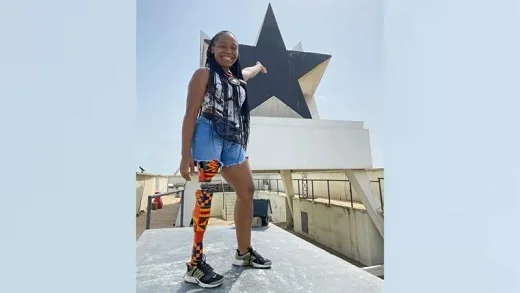
She has never fit neatly into the familiar narrative of a person quietly and bravely “overcoming” adversity. And she has never wanted to.
Abena rejects, outright, the stereotype often imposed on disabled children — that they must be gentle, compliant, exceptional students whose struggles are softened by sweetness. Her childhood looked nothing like that image.
“People imagine disabled kids as straight-A students who are sweet, quiet and perfect,” she says. “I was the opposite. I was loud. I was a little Black girl running around on one leg. I didn’t let anyone push me around, and I was struggling through school.”
Her disability did not dilute her personality; it sharpened it. That sharpness — which she now jokingly refers to as her “professionally inspirational” energy — would become the driving force behind her life’s work.
In the United States, Abena carved out a career as a writer, beginning with poetry before expanding into public speaking. Through her words, she shared her lived experiences, not to invite sympathy, but to challenge people to reflect on their own potential. “I want people to see what I’m accomplishing,” she explains, “and let me hold up a mirror so you can see what you can accomplish if you believe.”
Long before she ever stepped onto a stage or into the public eye, however, Abena felt a quiet pull toward Africa — a pull she could not fully explain, but could not ignore. As a young adult in the US, she immersed herself in books about Africa before colonialism, especially the histories of West Africa. With every page, that pull intensified.
Her first visit to Ghana in 2021 transformed curiosity into certainty. Standing at Assin Manso in Ghana’s Central Region — the site where enslaved Africans were held before being forced south to the coast — she experienced what she describes as a moment that “rearranged my entire understanding of myself.” In that place, history and belonging collided, forming a sense of identity she had never known growing up in America.
Returning to the US was devastating. “It felt like I had finally found a missing part of myself,” she says. “Leaving Ghana felt like being torn away from somewhere my soul belonged.” Three months later, she packed her life into suitcases and moved permanently.
Ghana embraced her in ways she still struggles to articulate. Over four years in Accra, she has been claimed — with warmth, teasing, family bonds, and new names. She now lives with a Ghanaian mother who proudly introduces her as her daughter. “I am Ghanaian by ancestry and adoption,” Abena says. “My Ghanaian identity is not pretend. It is ancestral.”
That identity is visible even in her prosthetic leg, wrapped in vibrant kente cloth. “It always has been, and always will be, kente,” she says. “It represents my love for this country — its heritage, its pride.”
Living with a disability in Ghana has given Abena a renewed sense of purpose. She believes the greatest barrier disabled people face is not impairment, but invisibility. While progress in the US remains imperfect, she notes that disabled people are increasingly represented in public spaces. Ghana, she believes, is still at the beginning of that journey — not because of cruelty, but because of absence.
“Stigma thrives when people don’t see us in powerful, joyful or beautiful positions,” she says. Her advocacy is rooted in visibility, not pity. With her bold presence, cultural pride, and refusal to shrink herself, Abena wants to change how disability is seen.
“Disability is not the limitation,” she says. “Lack of support and lack of accessibility — that is what truly disables people.”
Please Login to comment in the post!

you may also like

- by Christian Amegbor
- Jun 21, 2023
The Art of Work-Life Balance: Nurturing Harmo...

- by Christian Amegbor
- Jun 21, 2023
Mindfulness in Everyday Life: Cultivating Inn...

- by Christian Amegbor
- Jun 21, 2023
Designing Your Dream Lifestyle: Crafting a Pe...
- by Christian Amegbor
- Feb 09, 2026