- by Christian Amegbor
- Feb 10, 2026
Enzo Maresca Identified as Manchester City's Top Choice to Replace Pep Guardiola — Reports
- By Christian Amegbor
- Apr Fri, 2026
- in Sports
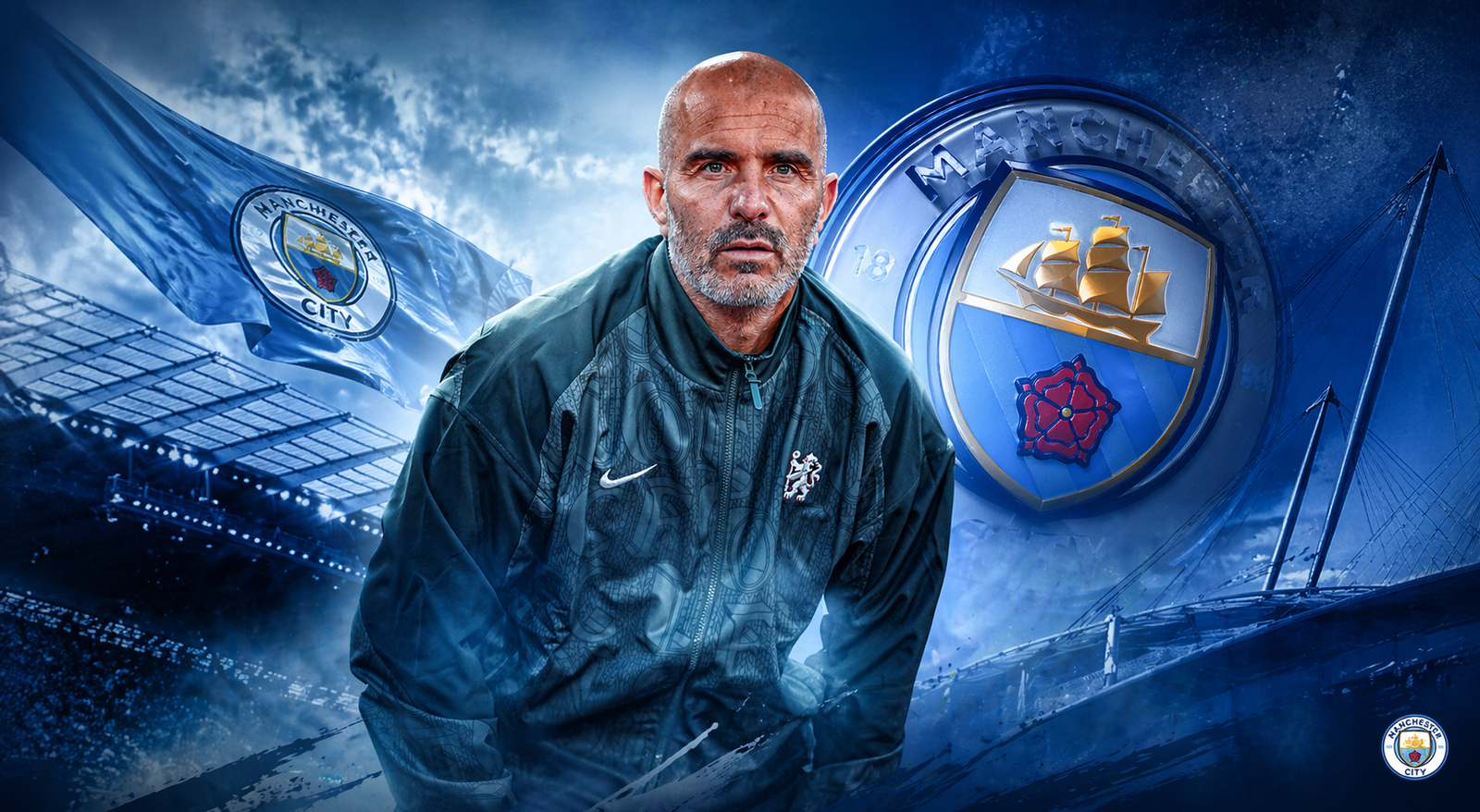
No club in English football plans further ahead than Manchester City. It is one of the defining characteristics of an organisation that has spent over a decade building not just a dominant team but a self-sustaining footballing institution, one designed to retain its competitive edge regardless of who is standing in the dugout. That planning is now being applied to the most consequential question in the club's near future: what happens when Pep Guardiola eventually walks away?
According to multiple reports, the City has already identified its answer. Enzo Maresca, the former manager of Chelsea and a coach with deep roots in the Manchester City system, is understood to be the club's preferred internal candidate to succeed Guardiola when the time comes. No official timeline exists, and Guardiola remains under contract with no confirmed departure imminent. But the groundwork, sources suggest, is already being laid.
Why Maresca and Why Now
The logic behind Maresca's candidacy is not difficult to understand once you examine his background and coaching profile in detail.
Before taking charge at Chelsea, Maresca spent formative years working within the Manchester City organisation, first developing his coaching credentials in the club's academy and feeder system structure, and later as a first-team assistant under Guardiola himself. That period gave him direct, sustained exposure to the tactical framework, positional principles, and organisational culture that have made City the dominant force in English football for the better part of a decade.
The result is a manager whose footballing philosophy is not merely compatible with Guardiola's, it is directly derived from it. Maresca's teams play possession-based, positionally structured football. They press with collective organisation rather than individual chaos. They build from the back through deliberate, patterned sequences. They prioritise territorial control and numerical superiority in key areas of the pitch.
These are not surface-level similarities. They represent a shared tactical language, the kind of deep alignment that allows a club to change its manager without changing its identity. For Manchester City, that continuity of identity is not a cosmetic preference. It is a strategic imperative, built into the way the squad is assembled, the way players are developed, and the way the club presents itself to potential signings.
Appointing a manager who understands and speaks that language from the inside eliminates the single greatest risk in any high-profile managerial transition: the loss of footballing coherence.
The Guardiola Variable
Any honest assessment of this situation must acknowledge the central unknown: Pep Guardiola's own timeline.
The Spanish manager, widely regarded as the greatest club coach of his generation, has shown no definitive signs of preparing to leave. He remains engaged, competitive, and contractually committed to the club. Manchester City, for its part, is not actively seeking to accelerate a transition; they want Guardiola for as long as Guardiola wants to be there.
But elite football management is a profession that demands enormous psychological and physical energy, and even the most driven coaches reach moments of natural conclusion. Guardiola has previously spoken openly about the finite nature of his tenures and the importance of knowing when to move on. City's decision to identify a successor now is not an act of impatience; it is an act of institutional maturity.
By positioning Maresca as the front-runner in advance, the club avoids the chaotic, reactive succession processes that have undermined clubs of comparable stature, rushed appointments, philosophical U-turns, and fractured dressing rooms. When the moment comes, City intends to be ready.
The Italian Complication
Maresca's growing reputation has not gone unnoticed beyond England. Multiple Serie A clubs are reported to be monitoring his situation with serious interest, viewing him as one of the most tactically sophisticated young managers in European football and a candidate capable of leading significant projects at the highest level of Italian football.
That external interest introduces a degree of competitive pressure into the City's succession calculations. Maresca will not wait indefinitely, and if the right opportunity presents itself in Italy or elsewhere, before the Manchester City position becomes available, there is no guarantee he will remain an accessible option.
City's advantage, however, is considerable. The combination of institutional familiarity, the scale of the project on offer, and the weight of the club's ambition gives them leverage that most competitors cannot match. Whether that leverage is sufficient to hold Maresca's interest across an uncertain timeframe remains one of the more intriguing subplots in English football's near future.
What a Maresca Era Would Look Like
Should the succession plan reach its conclusion, City supporters would experience something relatively rare in elite football, a managerial transition that feels evolutionary rather than revolutionary.
The tactical DNA of the club would remain recognisable. The possession-oriented, positionally structured approach that has defined the Guardiola era would persist under a manager who has internalised those principles at the deepest level. The player development pathways, the recruitment philosophy, and the performance standards embedded throughout the organisation would continue without the disruption that typically accompanies major managerial change.
That continuity extends to the dressing room. Players who have been developed and coached within the Guardiola system, and who represent the core of City's squad, would be managed by someone whose footballing vocabulary they already understand. The adjustment period, usually the most vulnerable phase of any managerial transition, would be substantially compressed.
In competitive terms, this matters enormously. The clubs that sustain success across managerial changes are invariably those that have built systems strong enough to transcend individuals. Manchester City believe they have built such a system. Enzo Maresca, they believe, is the right person to inherit it.
The Bigger Picture
Guardiola's eventual departure from Manchester City will be one of the defining moments in the history of the Premier League, a moment that marks the end of an era as comprehensively as Ferguson's retirement reshaped Manchester United in 2013. The difference is that City appears determined not to repeat the mistakes of that transition.
The identification of Maresca as a preferred successor is not a transfer rumour or a speculative leak. It is a signal, deliberate or otherwise, that this club's planning horizon extends well beyond the next fixture, the next transfer window, and the current contract cycle.
Manchester City is not waiting for the future to arrive. They are already preparing to meet it.
This story is developing. No official confirmation has been made by Manchester City or Enzo Maresca's representatives at the time of publication.

Please Login to comment in the post!

you may also like
- by Christian Amegbor
- Feb 11, 2026
Sesko's Late Equalizer Denies West Ham Victor...

- by Christian Amegbor
- Feb 12, 2026
Milner Hits Career Milestone but Brighton's S...
- by Christian Amegbor
- Feb 12, 2026
Ghana Midfielder Thomas Partey Charged With T...
- by Christian Amegbor
- Feb 13, 2026