- by Christian Amegbor
- Feb 10, 2026
UEFA Hands Gianluca Prestianni Six-Match Ban in Case Linked to Vinícius Júnior Incident
- By Christian Amegbor
- Apr Fri, 2026
- in Sports
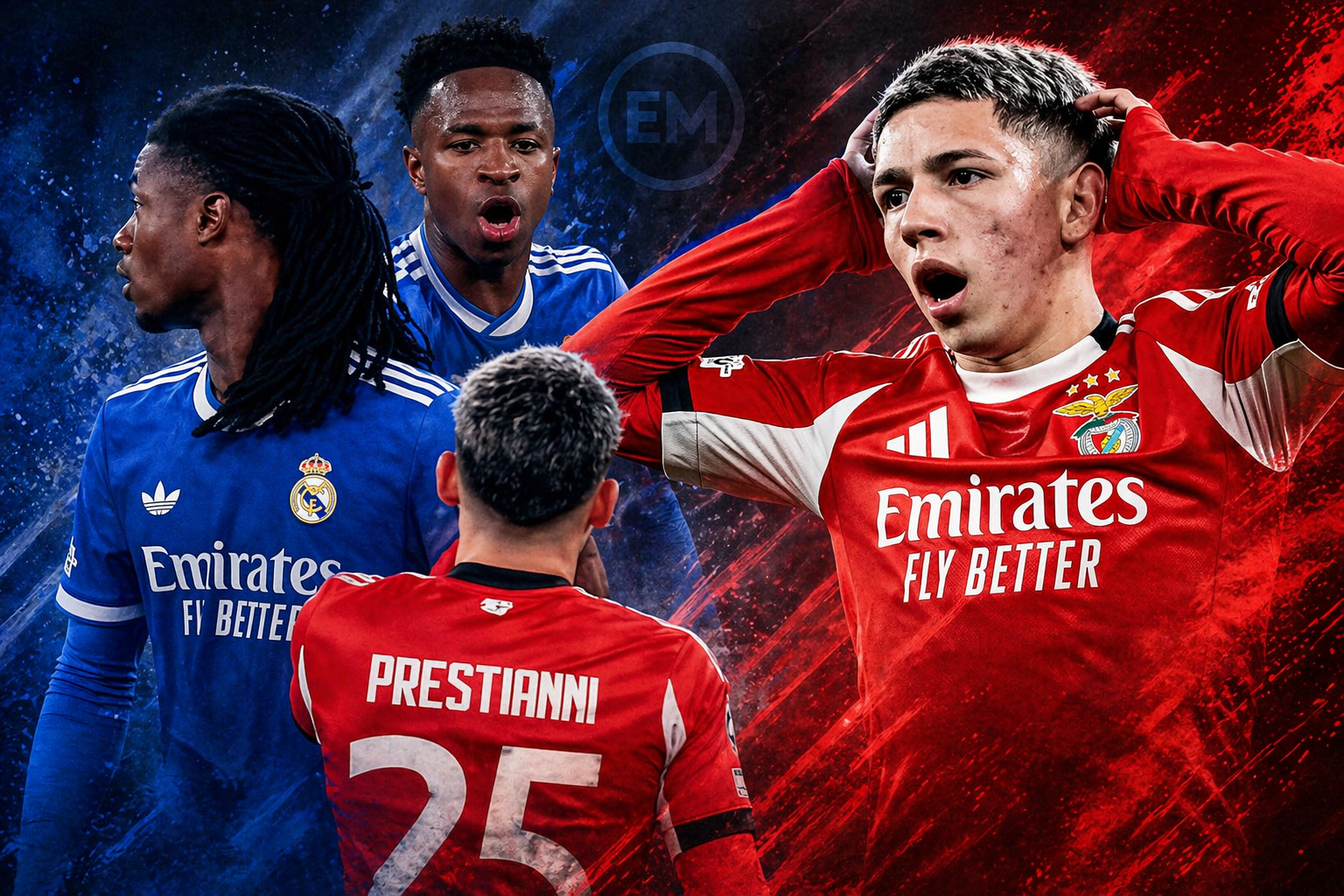
UEFA has issued a six-match suspension to Argentine footballer Gianluca Prestianni following the conclusion of a disciplinary investigation into an incident connected to Real Madrid forward Vinícius Júnior. This ruling has reverberated across the football world and reignited debate about player conduct, institutional accountability, and the protection of high-profile athletes in European competition.
The governing body confirmed the sanction after completing its formal review of the case, determining that the severity of the incident warranted one of the more substantial individual bans available under UEFA's disciplinary framework. Six matches in UEFA competition represent a significant punishment, one that carries real consequences for a young player's development, rhythm, and availability for his club during the European campaign.
UEFA has not released comprehensive public details on every specific aspect of the incident. Still, the governing body confirmed that the case centres on conduct directly linked to a situation involving Vinícius Júnior, whose experiences with on-field misconduct and targeted abuse have made him one of the most scrutinised and, in disciplinary terms, most consequential figures in modern European football.
The Weight of a Six-Match Ban
To understand the significance of this ruling, it is worth contextualising what a six-game UEFA suspension actually means within the governing body's disciplinary structure.
Bans of this length are not issued for minor or technical infringements. Under UEFA's code of conduct, sanctions in this range are typically associated with serious breaches, conduct classified as disrespectful, discriminatory, threatening, or otherwise seriously violating the standards the organisation requires of players competing under its jurisdiction. A one or two-match ban addresses a serious foul or a red card accumulation. A six-match ban communicates something categorically different: that the governing body assessed the conduct in question as a significant violation demanding a strong and visible corrective response.
For Prestianni, the practical implications are considerable. Missing six competitive UEFA fixtures during a formative period of a young career disrupts momentum, breaks competitive rhythm, and removes the player from the highest-level environment in which development accelerates most rapidly. The suspension is not merely a punishment; it is an interruption to a career trajectory at a moment when continuity matters enormously.
Vinícius Júnior and the Pattern of Targeted Misconduct
This case cannot be fully understood without acknowledging the broader context surrounding Vinícius Júnior and the treatment he has repeatedly faced across European football.
The Brazilian forward has been at the centre of multiple high-profile disciplinary cases in recent seasons, many of them involving racial abuse, targeted harassment, and conduct from opponents, fans, and officials that has consistently drawn condemnation from football's governing bodies, players' organisations, and human rights groups alike. UEFA, La Liga, and FIFA have each been compelled to respond to specific incidents involving Vinícius, and the cumulative effect has been to place his treatment in European football at the forefront of the sport's ongoing reckoning with racism, respect, and institutional responsibility.
The frequency with which incidents involving Vinícius require formal disciplinary intervention is itself a data point worth noting. It speaks to the particular pressure and provocation he operates under and to the fact that, despite repeated governance responses, the problem has not been resolved. Each new case, including this one involving Prestianni, adds to a pattern that UEFA has repeatedly pledged to address with increasing firmness.
The six-match ban, in this light, can be read as more than an individual sanction. It is a statement about the standards UEFA expects when incidents involve conduct directed at one of football's most targeted athletes.
UEFA's Disciplinary Stance and Its Critics
Reaction to the ruling has been predictably divided.
Supporters of the decision argue that UEFA has acted decisively and appropriately, that a six-match ban sends an unambiguous message to every player competing in European competition that misconduct of this nature will not be treated leniently, regardless of the nationality, age, or profile of the individual involved. In this reading, the ruling reflects exactly the kind of firm, consistent enforcement that the sport needs more of, not less.
Critics, however, have raised questions that UEFA has consistently struggled to answer to universal satisfaction: questions about the transparency of the disciplinary process, the consistency with which similar cases are treated across different nationalities and competitions, and whether the severity of punishments matches the severity of the offences they are designed to address.
These are not new criticisms. They have accompanied UEFA disciplinary decisions for years, and they reflect genuine tensions in how a governing body balances procedural rigour with public accountability. UEFA's disciplinary hearings are not public proceedings, and the limited detail released in rulings like this one, while legally defensible, tends to fuel speculation and debate rather than resolve it.
What This Means Going Forward
For Gianluca Prestianni, the immediate priority is to serve the suspension, reflect on the conduct that led to it, and return to competition with a clearer understanding of the standards required at the elite European level. Young players operating in the intensity of UEFA competition are under enormous pressure, but that pressure does not diminish the responsibility each athlete carries in terms of conduct and respect.
For UEFA, the ruling represents another data point in the governing body's ongoing effort to position itself as a credible enforcer of fair play and player welfare standards. Whether individual sanctions of this nature are sufficient to shift the broader culture around targeted misconduct in European football remains an open and genuinely difficult question.
What is not in question is the governing body's intent. UEFA has made clear, through this ruling and others like it, that incidents involving misconduct toward players, particularly those with Vinícius Júnior's documented history of being targeted, will be taken seriously and punished substantively.
Whether that seriousness translates into meaningful, lasting change is the larger test that European football's governing institutions continue to face.

Please Login to comment in the post!
you may also like
- by Christian Amegbor
- Feb 11, 2026
Sesko's Late Equalizer Denies West Ham Victor...
- by Christian Amegbor
- Feb 12, 2026
Milner Hits Career Milestone but Brighton's S...
- by Christian Amegbor
- Feb 12, 2026
Ghana Midfielder Thomas Partey Charged With T...
- by Christian Amegbor
- Feb 13, 2026