- by Christian Amegbor
- Feb 10, 2026
FIFA Set to Introduce Major Yellow Card Rule Change for World Cup Knockout Stages
- By Christian Amegbor
- Apr Tue, 2026
- in Sports
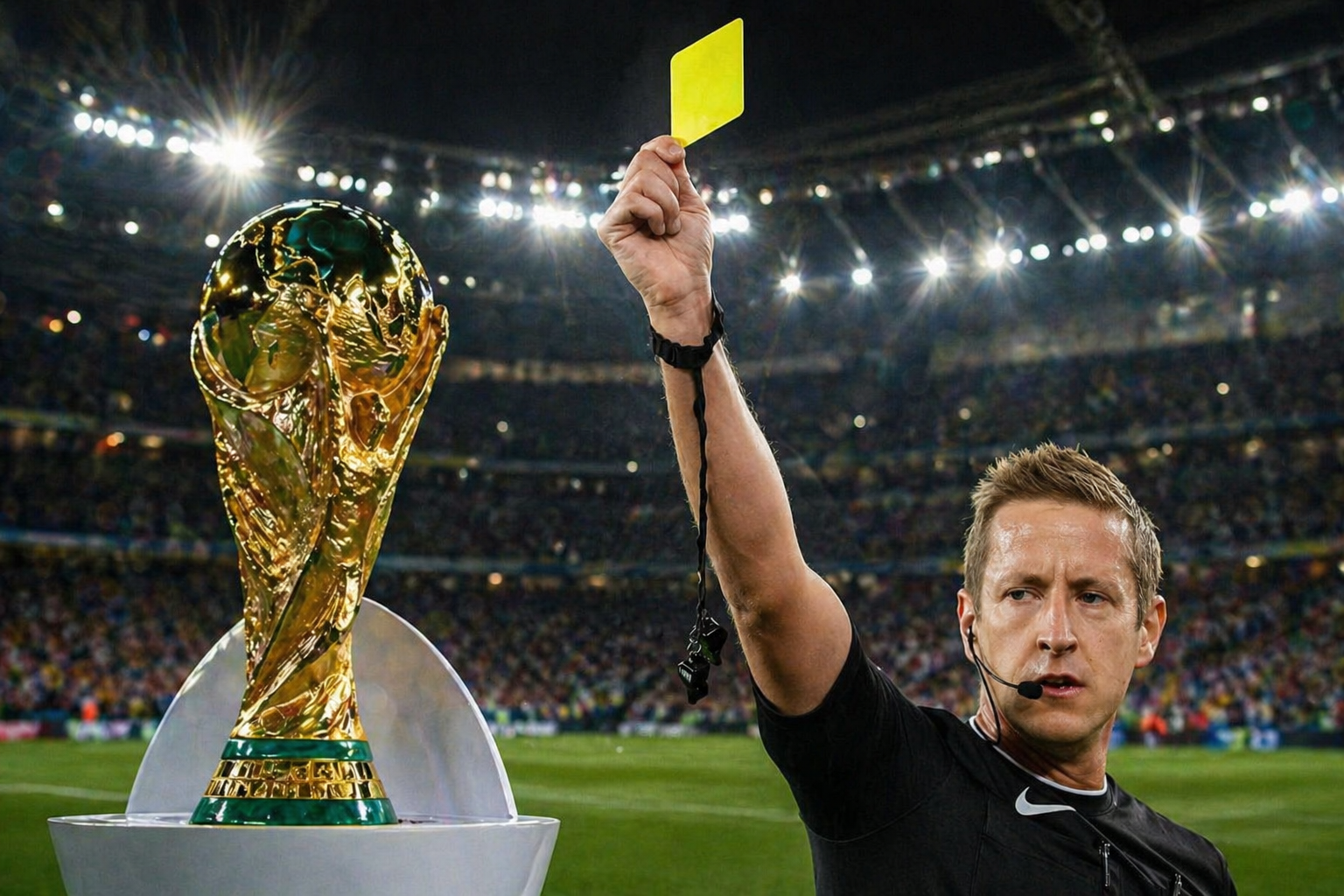
FIFA is reportedly moving toward one of its most consequential disciplinary rule changes in recent memory, and if approved, it could fundamentally alter how teams approach tournament football at the highest level.
The governing body is expected to greenlight a policy that clears all accumulated yellow cards at two fixed points during the FIFA World Cup: at the conclusion of the group stage, and again after the quarter-finals. The aim is direct: to prevent top players from missing the tournament's most important matches due to suspension.
The Problem FIFA Is Trying to Solve
Under the existing system, yellow card accumulation across matches triggers automatic bans, a mechanism that has repeatedly produced one of football's most uncomfortable spectacles: watching a semi-final or a final without the players who defined the earlier rounds.
The frustration is not new. Fans and analysts have long argued that suspension-by-accumulation can distort the outcomes of the biggest games in world football, punishing natural competitiveness rather than genuine misconduct. FIFA appears to have heard that argument and is now acting on it.
By resetting bookings after the group stage, every team enters the knockout rounds with a clean disciplinary slate. The second reset, applied after the quarter-finals, extends that guarantee deeper into the tournament, ensuring that semi-finals and the final are contested by squads at full strength, unencumbered by cautions earned in matches played weeks earlier.
A Tactical Landscape Transformed
Beyond the headlines, this change carries significant tactical implications; coaches will be the first to recalibrate.
Under the current system, players walking a disciplinary tightrope during the group stage often modify their game to avoid suspension: pulling out of challenges, tempering their press, managing physicality. That calculation disappears with a post-group reset in place.
Knowing that bookings will not carry forward, teams may adopt more aggressive pressing structures, commit more readily to tactical fouls, and embrace higher-intensity play in matches where the only consequence is the result in front of them. For tightly contested group-stage fixtures, where a decisive tackle or a well-timed foul can shift the momentum entirely, the psychological and tactical freedom this rule provides could be considerable.
The Counterargument: Discipline at Risk?
Not everyone will welcome the change without reservation.
Critics of the proposal argue that severing the long-term consequences of yellow cards reduces accountability and could invite recklessness. If a player knows their booking is erased in a matter of days, the deterrent effect of a caution diminishes, potentially opening the door to more cynical challenges and a harder physical edge throughout the tournament.
FIFA's response to this concern will rest heavily on refereeing standards. Red cards, straight dismissals, and match bans for serious offences must remain firmly enforced to prevent the rule change from becoming a licence for dangerous play. The burden on officials to manage the line between competitive intensity and endangerment will, if anything, increase.
Aligned With Modern Practice
This is not without precedent. UEFA has operated yellow card reset mechanisms at various stages of its major competitions for years, specifically to preserve the quality and fairness of the latter rounds. FIFA's proposal would align the World Cup with that approach, a convergence that makes sense given the two competitions sit at the apex of the international game.
The World Cup, with its compressed schedule and the weight of expectation it carries, arguably has more to gain from such a system than any other tournament. The stakes in each knockout fixture are absolute. The margin for administrative misfortune should, in theory, be as narrow as possible.
What It Means for Players and Fans
For elite players, the shift is liberating. The anxious arithmetic of accumulated bookings, calculating whether to challenge, whether to press, whether to risk a foul in a group-stage dead rubber, becomes irrelevant. They can play each match on its own terms, at full intensity, without one eye on a potential semi-final suspension.
For supporters, the reward is more straightforward: a greater chance of seeing the world's best players in the world's biggest matches. The prospect of a World Cup final featuring depleted squads stripped of key figures by caution accumulation has always been an unsatisfying one. This rule change directly addresses that.
The Bigger Picture
FIFA's move, if confirmed, is consistent with a broader institutional push to strengthen competitive integrity and enhance the entertainment value of the tournament. Reducing the role that administrative suspensions play in shaping outcomes is a logical step, one that prioritises footballing quality over procedural mechanics.
Whether it transforms the tactical landscape, emboldens players, or simply removes an unnecessary source of frustration, the yellow card reset could become one of the defining structural features of the modern World Cup.
The only question now is whether FIFA delivers the approval to match its reported intentions.

Please Login to comment in the post!

you may also like

- by Christian Amegbor
- Feb 11, 2026
Sesko's Late Equalizer Denies West Ham Victor...

- by Christian Amegbor
- Feb 12, 2026
Milner Hits Career Milestone but Brighton's S...

- by Christian Amegbor
- Feb 12, 2026
Ghana Midfielder Thomas Partey Charged With T...

- by Christian Amegbor
- Feb 13, 2026