- by Christian Amegbor
- Feb 10, 2026
PSG vs Bayern Munich Sets Champions League Record in Historic 9-Goal Semi-Final Thriller
- By Christian Amegbor
- Apr Wed, 2026
- in Sports
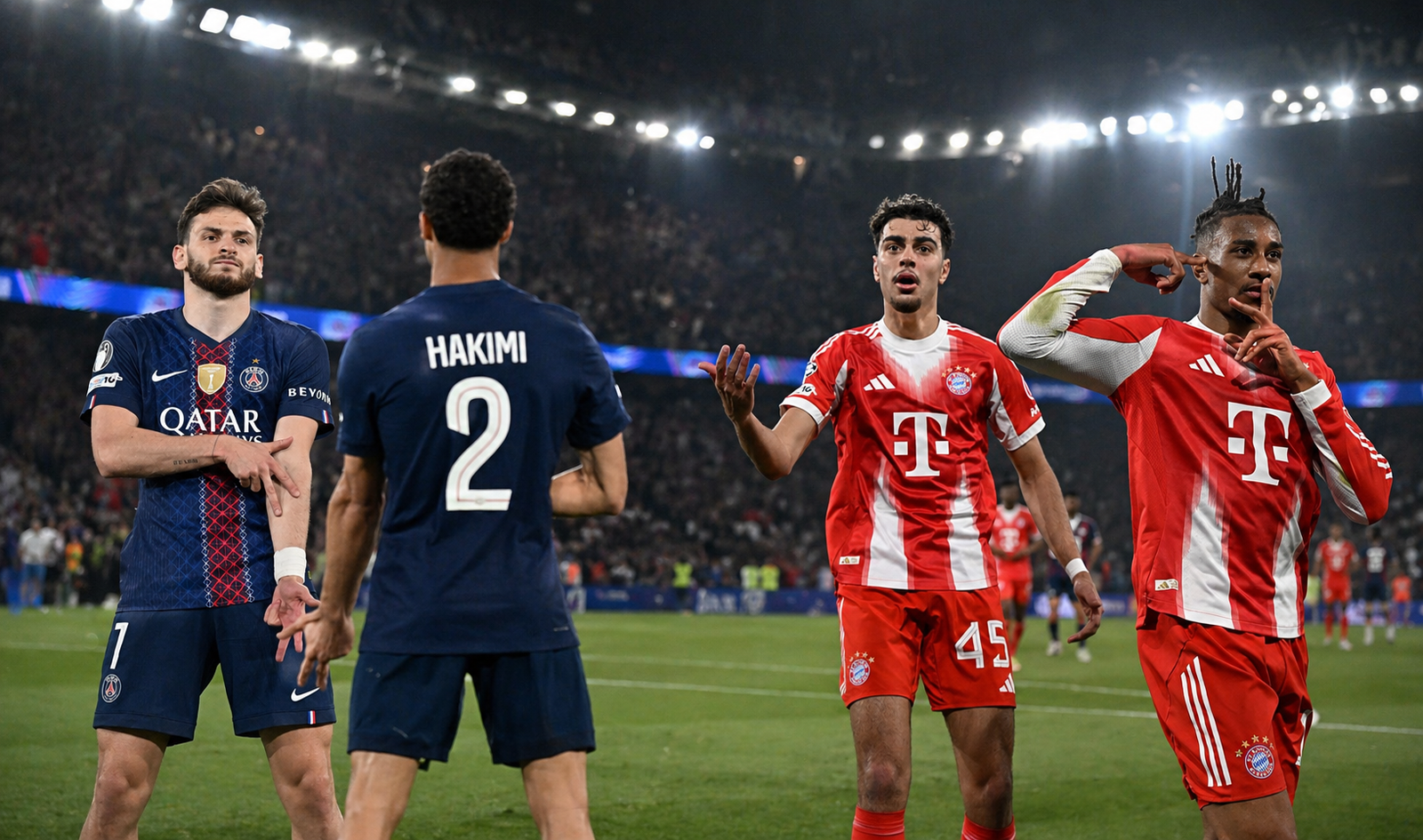
Paris Saint-Germain and Bayern Munich have produced a match that will be replayed in football conversations for decades.
The first leg of their UEFA Champions League semi-final ended 5-4 in favour of PSG; nine goals in a single knockout fixture at the penultimate stage of Europe's premier club competition. It is, officially, the highest-scoring semi-final in Champions League history. And it was every bit as chaotic, brilliant, and breathless as that record suggests.
How It Unfolded
Bayern drew first blood through Harry Kane, the clinical finish carrying the authority of a team that arrived in Paris with genuine belief. But PSG, playing with the kind of fluid, relentless attacking intent that has defined their European campaign, refused to yield.
Khvicha Kvaratskhelia and João Neves swung momentum in the hosts' favour before Ousmane Dembélé settled into the role of chief architect, delivering a decisive brace that helped construct a commanding 5-2 lead. At that point, the tide appeared to be drifting decisively toward Paris.
Bayern, to their credit, refused to accept it. A dramatic late surge, goals that forced PSG's backline into repeated scrambles, narrowed the deficit to 5-4, keeping the second leg alive and injecting the kind of psychological complexity that will define the contest in Munich.
A Record That Stands Alone
Champions League semi-finals are not supposed to look like this. Historically, the penultimate stage of the competition has been defined by defensive caution, tactical restraint, and the calculated management of risk. Teams arrive at this point knowing one error can end a season. The instinct is to protect.
PSG and Bayern discarded that instinct entirely.
To understand how rare this is, consider the context. Liverpool's thrilling semi-final against Roma in 2018 finished 7-6 on aggregate, but spread across two legs. Barcelona's infamous 8-2 demolition of Bayern is etched into the competition's folklore, but that was a quarter-final, played in a condensed bubble format stripped of its usual two-legged structure. Nine goals in a single semi-final match, in normal competition conditions, has simply never happened before at this stage of the Champions League.
Not in the era of Ronaldo and Messi. Not across the decades of Real Madrid's continental dominance. Not in any of Manchester City's high-octane European campaigns. This fixture stands alone.
The Tactical Picture
What made the match extraordinary was not just the volume of goals but the quality of the football producing them, and the distinct tactical identities that collided to generate it.
PSG operated through fluid attacking transitions, sharp positional interchange, and the kind of technical precision in tight spaces that makes their forward line so difficult to contain consistently. Their attacking trio overwhelmed Bayern's defensive structure with movement that shifted between the lines and stretched the shape at both width and depth.
Bayern, meanwhile, pressed with characteristic intensity and leaned on direct play, looking to exploit the space PSG's aggressive positioning inevitably created. Michael Olise and Luis Díaz were instrumental in stretching the game and creating the moments of individual quality that a contest of this nature demands.
Analysts watching in real time reached for a phrase that feels apt: artistic chaos. It was not a match without structure; both managers had clear tactical frameworks operating throughout, but the structural frameworks could not contain what the players were producing. The football was too good, too fast, and too willing to take risks.
Who Holds the Advantage?
PSG leads by a single goal. That is the cold, technical reality.
But football operates on more than arithmetic, and Bayern's late comeback has introduced a psychological dimension that a straightforward 5-2 scoreline would not have permitted. They travel to Munich having demonstrated that they can score against this PSG side, and that they will not surrender quietly when the tie turns against them.
PSG, for their part, carries the confidence of a team that has shown they can outscore anyone in Europe on a given night. One goal is a lead. In the context of what both of these attacks are capable of, it is also an invitation.
The winner will face either Arsenal or Atlético Madrid in the final, a conclusion to the tournament that, regardless of who advances, carries the weight of history.
What This Match Tells Us
Beyond the record, beyond the drama, this semi-final carries a broader significance. For years, the debate around elite European football has circled the tension between defensive solidity and attacking ambition, the argument that the highest-stakes matches inevitably default to caution, that truly open, expressive football belongs to earlier rounds.
PSG and Bayern have challenged that narrative directly. They played the biggest game of their respective seasons as if neither had received the tactical memo about restraint. The football they produced was elite, entertaining, and genuinely historic.
The second leg awaits. If the first encounter is any measure of what these two teams are prepared to offer, the record books may not be finished yet.

Please Login to comment in the post!
you may also like
- by Christian Amegbor
- Feb 11, 2026
Sesko's Late Equalizer Denies West Ham Victor...
- by Christian Amegbor
- Feb 12, 2026
Milner Hits Career Milestone but Brighton's S...
- by Christian Amegbor
- Feb 12, 2026
Ghana Midfielder Thomas Partey Charged With T...
- by Christian Amegbor
- Feb 13, 2026