The Electricity Company of Ghana (ECG) Embraces Drone Technology to Modernise Transmission Monitoring
- By Christian Amegbor
- Apr Tue, 2026
- in Tech News
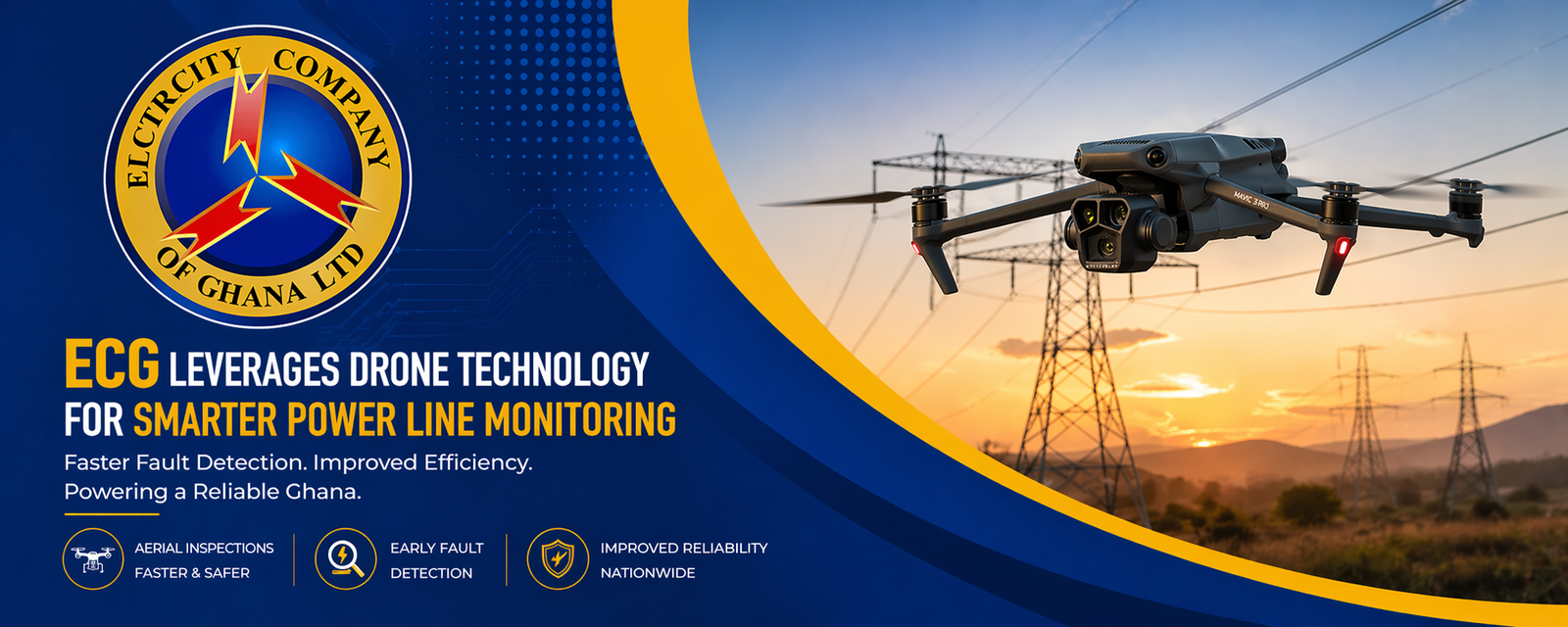
For decades, the men and women tasked with keeping Ghana's lights on have done so largely on foot, traversing thousands of kilometres of power-line corridor through forest, farmland, and floodplain, armed with little more than binoculars and clipboards. That era is ending.
The Electricity Company of Ghana (ECG) has launched a strategic programme to integrate autonomous drone technology into its transmission line monitoring operations, a shift that promises to fundamentally transform the economics, safety, and reliability of infrastructure maintenance across the country.
From Reactive to Predictive
Traditional line inspection has always been a reactive discipline. Field crews respond to reported faults, often arriving only after supply to customers has already been disrupted. The drones' ECG is now deploying to invert this logic entirely. Equipped with high-resolution optical cameras and advanced multispectral sensors, the aircraft can detect damaged conductors, vegetation encroachment, and structural fatigue in transmission towers long before any fault becomes a failure. Aerial data feeds directly into maintenance scheduling systems, allowing engineering teams to prioritise repair work by risk rather than by geography alone.
Inspections that once consumed entire working days can now be completed within hours, producing richer, more accurate records than any manual survey could provide. This is particularly significant in remote and difficult terrain, where traditional methods are not only slow but often logistically impractical.
A Dividend for Worker Safety
Beyond the operational gains, the humanitarian case for drone-based inspection deserves equal weight. Live high-voltage infrastructure presents serious hazards to field personnel, especially during the wet season when terrain becomes unpredictable. By removing the requirement for routine human proximity to energised lines, ECG is eliminating an entire category of occupational risk. In this respect, the programme is as much a worker-protection initiative as it is an efficiency measure.
Data as Infrastructure
Each drone sortie generates a structured dataset, georeferenced imagery, thermal signatures, and anomaly classifications that accumulate over time into a living record of the network's condition. This is perhaps the deepest value of the programme. Individual inspections improve specific maintenance decisions; the aggregate data, analysed over months and years, reveals systemic vulnerabilities and informs long-term capital planning. ECG's network gains an institutional memory it has never previously possessed.
This approach places Ghana firmly within global best practice in smart-grid management, where data-driven asset stewardship is increasingly the standard among leading utilities worldwide.
Meeting the Demands of a Growing Nation
Ghana's electricity demand is rising on every front simultaneously, driven by industrial expansion, the rapid growth of digital services, accelerating urbanisation, and national ambitions for broader electrification. A transmission network that still depends on manual inspection cannot keep pace with that growth, nor can it deliver the reliability that investors, businesses, and households now expect.
ECG's drone programme is, in this context, not a luxury upgrade but a structural necessity, the kind of foundational investment that distinguishes a utility capable of supporting a modern economy from one perpetually playing catch-up.
For Ghanaians, the most visible measure of success will ultimately be simple: fewer outages, faster restorations, and the steady confidence that the infrastructure underpinning everyday life is being maintained with rigour, foresight, and care. The drones, unseen above the canopy, are already at work making that promise real.

Please Login to comment in the post!