-
 by Em News
- September 18, 2026
GCB Bank MSME Business Clinic Connects Accra Entrepreneurs to Finance, Digital Skills and Trade Opportunities
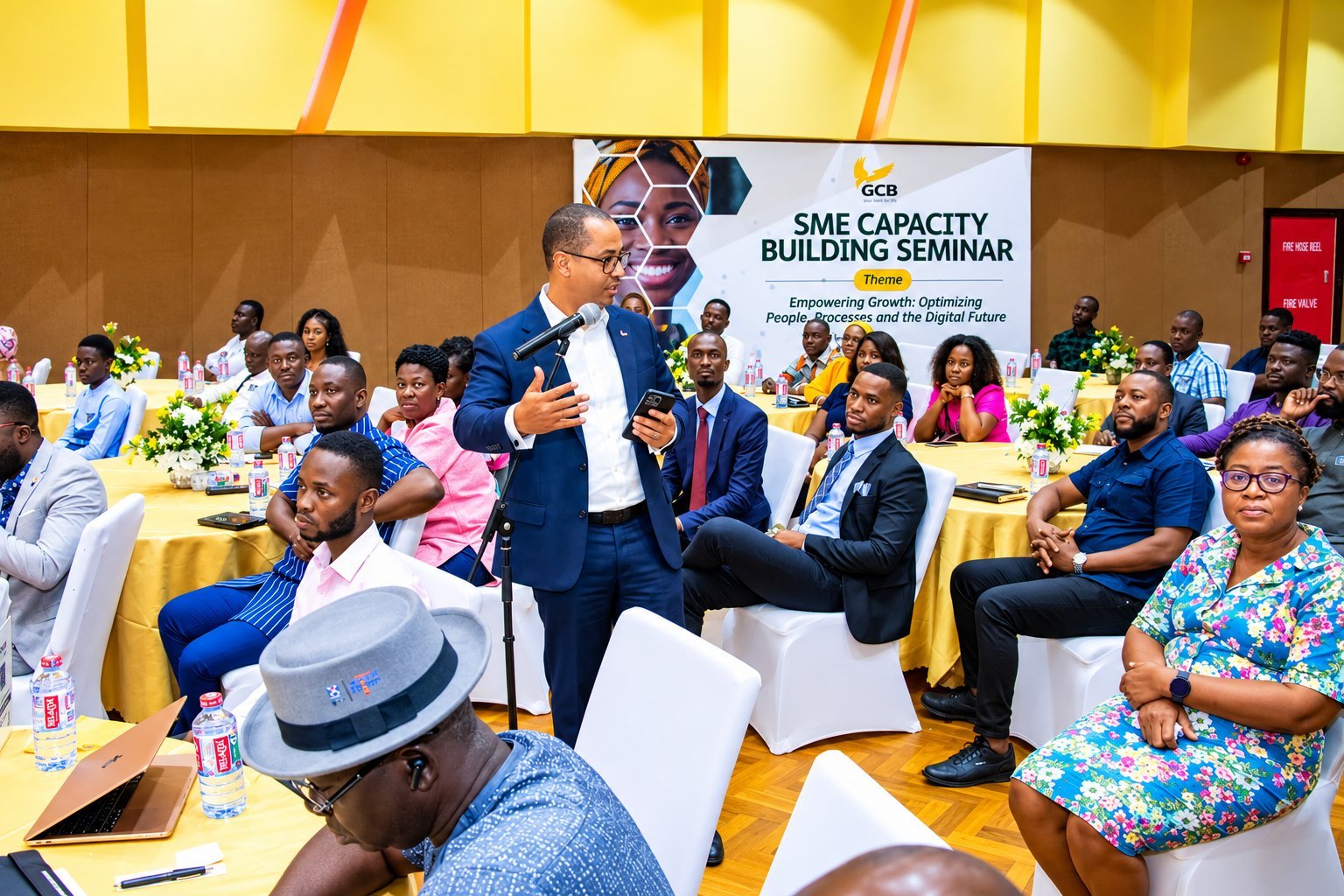
Entrepreneurs receive practical guidance on business formalisation, AI-powered marketing, access to finance and opportunities in international trade
ACCRA - For many small business owners in Ghana, the challenge of growth often comes down to one pressing question: how do I find the money to expand?
But at GCB Bank's MSME Business Clinic in Accra, entrepreneurs were encouraged to look beyond finance and consider the wider foundations needed to build businesses that can survive, scale and compete.
Held at the Accra City Hotel, the clinic brought together owners of Micro, Small and Medium Enterprises (MSMEs), banking professionals and business experts for discussions on financing, business formalisation, digital marketing and international trade.
The sessions focused on practical challenges entrepreneurs encounter as they attempt to move from small, often owner-dependent operations into more structured businesses.
For participants, the issues were familiar: keeping proper financial records, accessing suitable financing, reaching customers online, adopting new technologies and finding opportunities beyond Ghana's domestic market.
GCB Bank used the clinic to position these challenges as interconnected rather than separate problems.
The underlying message was straightforward: capital can help a business grow, but money alone cannot fix weak structures, poor financial management or an inability to reach customers.
GCB Bank puts MSME growth in focus
Speaking at the event, Executive Head of Commercial and Business Banking at GCB Bank, Alhassan Iddrisu Danaa, said the initiative formed part of the bank's efforts to strengthen its engagement with Ghanaian MSMEs.
“The GCB Bank MSME Caravan was birthed from GCB's position as a leading partner to MSMEs in Ghana and its ambition to help businesses build capacity and scale,” he said.
For many entrepreneurs, the challenge is not necessarily a lack of ideas or customers.
A small business may be generating sales but still struggle to secure financing because it lacks reliable financial records, clearly documented cash flow or the organisational structures lenders need to assess its ability to repay.
Others may secure funding but struggle to convert that capital into sustainable growth.
The clinic sought to address both sides of that equation by combining conversations about financial services with practical guidance on running a stronger business.
Turning small businesses into structured enterprises
Business formalisation was among the key issues discussed.
Dr Boahemaa Ntim, Managing Partner at Blacksmith Africa Consulting, encouraged entrepreneurs to think about the structures behind their businesses rather than focusing exclusively on day-to-day sales.
For a small enterprise, formalisation can easily be seen as paperwork, registering a business, keeping accounts, documenting transactions, or introducing internal processes.
But those systems become increasingly important as a company grows.
Reliable records can help an entrepreneur understand whether the business is actually profitable, where money is being spent and how much working capital is required.
They can also become important when approaching a bank for financing, negotiating with investors, applying for contracts or seeking partnerships with larger companies.
Formalisation can also reduce a common vulnerability among small businesses: excessive dependence on the founder.
When every payment, customer relationship and operational decision depends on one individual, growth becomes difficult to manage.
Building systems around the business can allow responsibilities to be delegated, performance to be measured, and operations to continue even when the owner is not personally handling every task.
The discussion therefore placed formalisation not simply as a regulatory requirement, but as part of the transition from running a small operation to building an institution capable of growing.
AI moves from buzzword to business tool
Technology was another major part of the conversation.
GCB Bank's Digital and Social Media Lead, Naa Abeka Nunoo, led an interactive session on how entrepreneurs can incorporate artificial intelligence into their marketing activities.
AI has rapidly entered business conversations, but for many small entrepreneurs, the more useful question is not what the technology can theoretically do. It is what it can do for their businesses today.
For a small retailer, restaurant, beauty brand, manufacturer or professional service provider, that could mean using AI to generate ideas for social media campaigns, improve product descriptions, draft customer communications or better organise marketing content.
Digital platforms have already lowered some of the barriers that once made advertising expensive for small businesses.
A company no longer necessarily needs a large advertising budget to introduce its products to thousands of potential customers.
AI could lower some of those barriers further.
But technology by itself does not create a marketing strategy.
A business still needs to understand who its customers are, what they want, and which platforms they use. Content generated quickly has little value if it does not connect with the people the business is trying to reach.
The session therefore placed technology within a broader marketing conversation rather than presenting AI as a substitute for business judgment.
Can more Ghanaian businesses sell beyond Ghana?
The clinic also turned its attention to international trade.
Joseph Clottiah Quaye, Head of Trade & Working Capital at GCB Bank, discussed the opportunities and requirements businesses need to consider when entering cross-border markets.
For many small businesses, exporting can appear intimidating.
Finding overseas buyers is only part of the process.
Businesses also need to understand documentation, shipping, payment arrangements, foreign exchange, working capital, and the financial risks involved when goods and money move across borders.
An exporter, for example, may need to pay suppliers and production costs long before receiving payment from an overseas customer.
That gap creates a working-capital challenge.
Financial institutions can play a role by providing payment infrastructure and appropriate trade-finance products, while businesses themselves need to understand the commercial and financial obligations associated with cross-border transactions.
For Ghanaian entrepreneurs looking beyond the domestic market, those details can determine whether an export opportunity becomes a sustainable business line or an expensive mistake.
Finance remains crucial, but so does financial readiness
Access to credit remains one of the most frequently discussed challenges facing small businesses.
Yet there is another side to the financing conversation.
Businesses seeking capital also need to be able to demonstrate how the money will be used and, where lending is involved, how it will be repaid.
That requires financial records, cash-flow management and a realistic understanding of the economics of the business.
A company generating strong sales can still experience financial difficulties if customers pay late, operating costs are poorly controlled, or the owner cannot distinguish revenue from profit.
That is why business-development programmes increasingly have to address financial literacy alongside access to capital.
The question is not simply whether financing is available.
It is whether entrepreneurs are financially prepared to use it effectively.
Beyond another business conference
The real measure of the MSME Business Clinic will come after participants leave the conference room.
Workshops and presentations can introduce entrepreneurs to new ideas, but their impact depends on whether those ideas translate into changes inside individual businesses.
That might mean opening proper business accounts, separating personal and company finances, keeping better records, or developing a more disciplined approach to cash flow.
For another entrepreneur, the next step could be experimenting with digital marketing, researching an export market or approaching a financial institution with a more credible business proposal.
Not every business attending the clinic will need the same intervention.
But that is precisely why capacity-building programmes can matter: the obstacles preventing one company from growing may be completely different from those holding back another.
Building stronger Ghanaian businesses
Ghana's small businesses operate in a difficult environment where access to finance is only one of several pressures.
Entrepreneurs also have to manage operating costs, changing consumer behaviour, technology, competition and the challenge of building businesses that can function beyond their founders.
No single clinic can solve those problems.
What such initiatives can do is give business owners access to knowledge, financial institutions and expertise that may otherwise be difficult to obtain.
For GCB Bank, the MSME Business Clinic also provides an opportunity to engage more closely with businesses whose growth could translate into deeper demand for banking, payments, trade finance and other financial services.
For the entrepreneurs, however, the calculation is more immediate.
Can they take what they learned and use it to make their businesses stronger?
That could mean becoming more organised before seeking a loan, understanding the numbers behind a business decision, finding customers through digital channels or preparing a product for markets outside Ghana.
The Accra clinic ultimately reinforced a simple point about entrepreneurship: starting a business and building a sustainable company are not the same thing.
Finance matters. So do customers.
But lasting growth also depends on structure, financial discipline, technology, market knowledge, and the ability to adapt as the business becomes more complex.
For Ghana's MSMEs, bringing those pieces together may be just as important as finding the capital to grow.
you may also like


-
by Em News
- September 19, 2026
Government Launches First Phase of Major Toma...

-
by Em News
- September 19, 2026
Secured Credit Hits GH¢31.5bn in Q2 2026 as L...
-
by Em News
- September 19, 2026
MTN Ghana Steps Up Push to Take Digital Payme...
-
by Em News
- September 20, 2026
0 Comments
Be the first to join the conversation.