-
 by Em News
- September 18, 2026
Lionel Messi Bows Out of Argentina Duty With Goal and Two Assists in 3–0 Win Over Benin
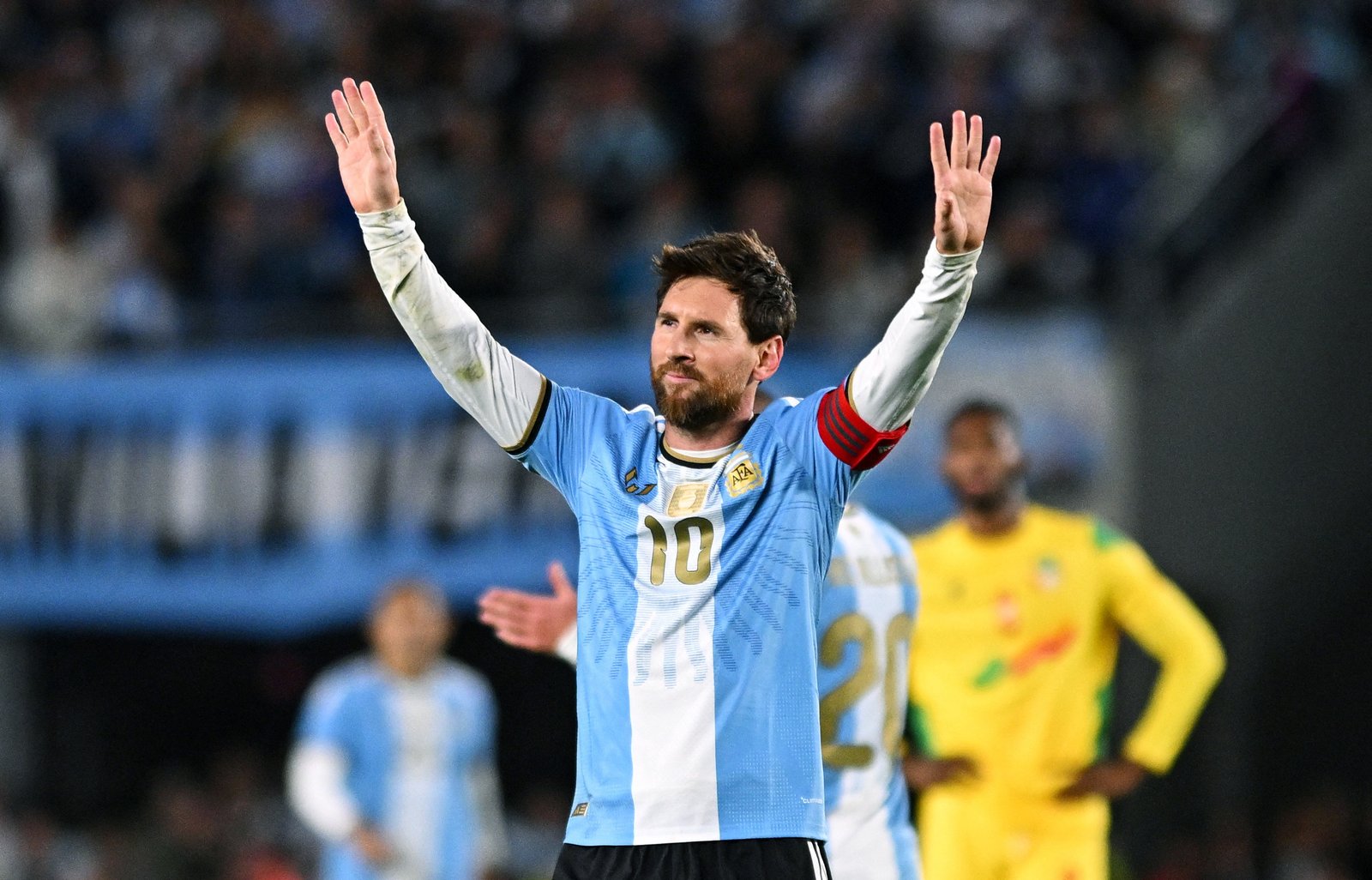
After 21 years, 208 appearances and 126 goals, Lionel Messi brought his Argentina career to an emotional close at the Monumental, yet still found time for one final decisive performance.
BUENOS AIRES — Lionel Messi had spent more than two decades carrying Argentina's hopes on football's biggest stages.
On Tuesday night, Argentina came to say thank you.
In his 208th and final international appearance, Messi scored from the penalty spot and created two more goals as Argentina defeated Benin 3–0 in an emotional farewell friendly at a packed Estadio Monumental in Buenos Aires.
More than 85,000 supporters filled the stadium for one final glimpse of their captain in the famous blue and white shirt.
They were not disappointed.
At 39, and with the evening built almost entirely around his farewell, Messi could easily have been forgiven for simply enjoying the occasion.
Instead, he remained at the centre of Argentina's football.
He created the opening goal for Nicolás Otamendi, set up Nico Paz for the second and then scored the third himself, converting a penalty in the 71st minute.
It was international goal number 126.
And this time, everyone inside the Monumental knew there would not be another.
One last Messi performance
The first half passed without a goal, but Argentina eventually broke through three minutes after the restart.
Messi delivered from a corner and veteran defender Nicolás Otamendi finished the move to put Argentina ahead in the 48th minute.
There was symbolism in the moment.
Otamendi, one of Messi's longest-serving Argentina teammates, was also making his final international appearance after sharing some of the national team's greatest triumphs and most painful defeats with the captain.
Messi then turned provider again in the 61st minute.
This time, the beneficiary was Nico Paz, one of the younger players expected to become increasingly important to Argentina as the national team moves into the post-Messi era.
Ten minutes later came the moment almost everyone inside the stadium had been waiting for.
Argentina were awarded a penalty.
Messi stepped forward.
One final run-up. One final finish.
The ball hit the net, the Monumental erupted, and Messi had his 126th and final goal for Argentina.
It completed a 3–0 victory and meant that, fittingly, the captain had played a direct role in all three goals on his farewell night.
Buenos Aires came to say goodbye
The result, though, was almost secondary.
This was never going to feel like an ordinary international friendly.
Hours before kick-off, supporters had already gathered to follow the Argentina team as it travelled towards the stadium.
Messi was visibly emotional on the journey.
Inside the Monumental, the tributes continued.
A giant Argentina shirt carrying Messi's No. 10 and the word "Gracias" was displayed as part of the farewell.
Former members of Argentina's World Cup-winning generations were among those present, connecting the country's footballing past with the player who had led its most recent period of success.
The match itself was paused in the 10th minute as the stadium rose to applaud the man who had made the number synonymous with his generation.
After the final whistle, there was little rush to leave.
Messi's teammates gathered around him. The chants continued from the stands. A drone display illuminated the night sky as Argentina celebrated the end of an era.
Messi, struggling with the emotion of the occasion, told the crowd how much representing his country had meant to him.
For more than 20 years, wearing the Argentina shirt had been one of the defining experiences of his life.
Now he had to say goodbye.
It was not always this way
The warmth surrounding Messi's farewell was striking partly because his relationship with the Argentina national team had not always been so uncomplicated.
For years, success at Barcelona created an almost impossible standard against which every international performance was judged.
He could win league titles, Champions League trophies and individual awards in Europe, but in Argentina the question followed him relentlessly:
When would he do it for the national team?
There were painful near misses.
Argentina lost the 2014 World Cup final to Germany.
Then came defeats in the Copa América finals of 2015 and 2016.
The 2016 loss was particularly painful. After Argentina were beaten by Chile on penalties, a devastated Messi announced that his international career was over.
For a moment, it appeared that his story with Argentina might end with frustration rather than fulfilment.
It didn't.
Messi returned, and the final years of his international career completely changed the way that story would be remembered.
The night everything began to change
The breakthrough came in 2021.
Argentina defeated Brazil at the Maracanã to win the Copa América, ending the country's long wait for a major senior international trophy and finally giving Messi the title that had eluded him.
A year later came another trophy when Argentina defeated Italy in the Finalissima.
Then came Qatar.
At the 2022 World Cup, Messi produced the tournament that had been missing from an already extraordinary career.
Argentina survived an opening defeat to Saudi Arabia, recovered through the knockout stages, and eventually met France in a final that became one of the most dramatic matches in World Cup history.
Messi scored twice.
Kylian Mbappé scored three.
After extra time ended 3–3, Argentina won the penalty shootout.
Messi finally lifted the World Cup.
The image of him holding the trophy became the defining picture of his international career.
The player who had spent years answering questions about what he had failed to win with Argentina had finally won the biggest prize of all.
Argentina would later add another Copa América title in 2024.
By the time Messi walked into the Monumental for his farewell, the debate surrounding his international legacy had long since disappeared.
There was nothing left to prove.
208 appearances, 126 goals, and much more
Messi leaves international football as Argentina's most-capped player and record goalscorer.
His final numbers stand at 208 appearances and 126 goals.
They are extraordinary figures, but numbers tell only part of the story.
Messi's international career stretched across generations.
He played alongside one group of Argentina stars, watched it disappear, became captain of another and eventually helped shape the generation that returned the country to the summit of world football.
There were extraordinary goals and assists, but there were also years of disappointment.
There was criticism.
There was the brief retirement.
There were lost finals.
And then there was redemption.
The Copa América changed the mood.
The World Cup changed everything.
By the end, the relationship between Messi and Argentina had become almost unrecognisable from the one that existed during the most difficult years of his international career.
The questions had been replaced by gratitude.
Argentina now faces life without No. 10
For Lionel Scaloni, the next challenge is one Argentina has known was coming but could never completely prepare for.
How do you replace Lionel Messi?
The answer is that Argentina probably cannot, at least not directly.
Messi was more than the player wearing the No. 10 shirt. He was the team's primary creator, goalscorer, captain and emotional reference point.
Argentina's next generation will therefore have to build something different rather than search for another version of him.
Nico Paz's goal on Tuesday offered a glimpse of that future.
Other young players will also assume greater responsibility as Scaloni reshapes the side around a generation that will no longer have Messi at its centre.
Argentina still possesses considerable talent.
What disappears is the certainty that, when a match becomes difficult, Lionel Messi might find something nobody else on the pitch can see.
That has been part of Argentina's footballing reality for more than two decades.
From now on, it won't be.
One last walk around the Monumental
When the final whistle sounded, Messi did not immediately disappear down the tunnel.
He stayed.
He embraced teammates and opponents and took in the noise from the stands.
The crowd stayed with him too.
For years, Argentina had demanded things from Messi, goals, trophies, performances and, eventually, a World Cup.
On Tuesday night, there was nothing left to demand.
The supporters simply applauded.
Messi took a final lap around the stadium, acknowledging the thousands who had come to see him wear the national shirt one last time.
Eventually, he reached the tunnel.
He turned towards the crowd, raised his arms and acknowledged them once more.
Then Lionel Messi walked away from international football.
He leaves as Argentina's record appearance-maker, its record goalscorer, a two-time Copa América winner and the captain who lifted the World Cup.
But his story with Argentina will always be about more than trophies.
It was a relationship that moved through expectation, criticism, disappointment, reconciliation and finally overwhelming affection.
His final match somehow captured the last part perfectly.
A packed Monumental. Two assists. One goal. A 3–0 victory.
And, after 21 years, one last goodbye.
Argentina had spent much of Messi's career asking him to deliver. On his final night, there was only one thing left for the country to say: Gracias, Leo.
you may also like

-
by Em News
- September 18, 2026
2026 Ballon d’Or: Kane, Yamal and Mbappé amon...
-
by Em News
- September 19, 2026
Independent Football Regulator and Betting: A...

-
by Em News
- September 19, 2026
Agyemang Badu Backs Queiroz to Bring Out the...
-
by Em News
- September 19, 2026
0 Comments
Be the first to join the conversation.